
Bloom’s Taxonomy and AI Integration
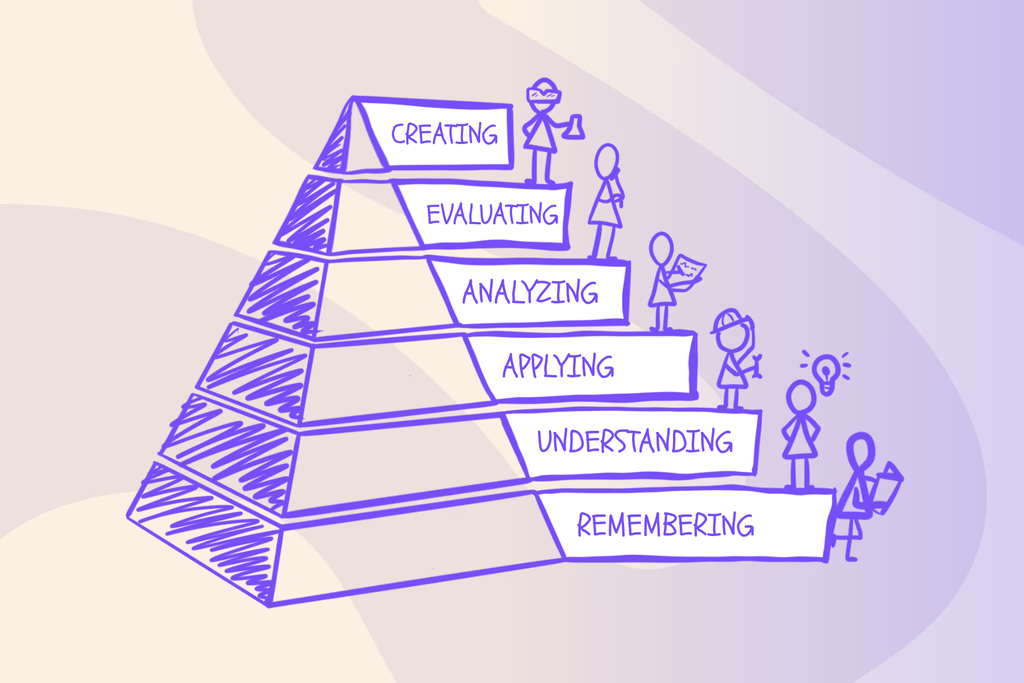
The use of innovative methods in education is always important for providing pupils with more efficient learning processes. In recent years, the integration of artificial intelligence (AI) technologies in education has gained significant attention. Bloom’s Taxonomy is a powerful tool that educators can use to develop pupils’ cognitive skills, and combining this taxonomy with AI can enhance the teaching process. This article discusses how Bloom’s Taxonomy can be integrated with artificial intelligence in education.
What is Bloom’s Taxonomy?
Bloom’s Taxonomy is a framework that ranks learning objectives into six different levels: Remembering, Understanding, Applying, Analysing, Evaluating, and Creating. This taxonomy helps pupils gradually develop their cognitive skills. Educators can design activities aimed at enhancing pupils’ skills at each level. Artificial intelligence, when integrated into these activities, can make the learning process more interactive and comprehensive.
AI and Bloom’s Taxonomy Unite
Artificial intelligence is an excellent tool for making pupils’ learning processes more interactive. AI-supported tools allow pupils to actively process information, providing effective learning opportunities at each level of Bloom’s Taxonomy. Below, we explore how AI integration can create activities for each level.
-
Remembering
The Remembering level involves pupils’ ability to recall information they have learned. Artificial intelligence can be used to remind pupils of information and encourage them to review it. For example, tools like ChatGPT can help pupils recall information they have learned in the past and ask them various questions to prepare for exams.
Example Activity: Pupils answer questions provided by artificial intelligence to recall the information they have learned.
-
Understanding
Understanding involves the ability to explain information in one’s own words and convey it to others. AI can provide interactive guidance to help pupils grasp concepts better. Chatbots, for example, can ask pupils to summarise texts or provide explanations to help them understand a topic.
Example Activity: Pupils summarise a text or provide an explanation on a topic based on the clarifications they receive from AI.
-
Applying
At the Applying level, pupils should be able to use the knowledge they have learned in new situations. AI-supported tools can provide pupils with practical tasks by relating the knowledge they have learned to real-world problems. For instance, pupils can participate in a problem-solving process with the assistance of AI.
Example Activity: Pupils address a topic and design a solution with the suggestions provided by AI.
-
Analysing
The Analysing level involves breaking down information, identifying relationships, and analysing it. AI tools can assist pupils in analysing data and examining the findings. For example, AI can provide pupils with datasets and scenarios for them to analyse.
Example Activity: Pupils analyse a dataset provided by AI and interpret the findings.
-
Evaluating
Evaluating involves judging information based on various criteria and making decisions. AI tools can guide pupils in evaluating their analyses and offering alternative solutions. This is particularly important for developing pupils’ critical thinking skills.
Example Activity: Pupils evaluate solution suggestions provided by AI and offer critiques on these solutions.
-
Creating
At the Creating level, pupils should be able to develop new ideas and solutions. AI provides tools that allow pupils to participate in creative processes. For example, generative AI tools can inspire pupils while they create their own projects.
Example Activity: Pupils design their own projects with the help of AI and share these projects with the class.
Conclusion
Artificial intelligence, when integrated into education, provides pupils with more interactive, creative, and in-depth learning opportunities through Bloom’s Taxonomy. Educators can use these tools to develop pupils’ skills at each cognitive level and create effective learning processes.
AI-supported activities not only help pupils acquire the necessary skills to succeed in the digital world of the future but also align with pedagogically grounded teaching strategies. These innovative approaches in education provide a productive and enriching experience for both teachers and pupils.
References
Bruff, D. (2024). Five categories of AI-integrated assignments with examples. Derek Bruff’s Blog. Retrieved from https://derekbruff.kit.com/posts/five-categories-of-ai-integrated-assignments-with-examples
Montclair State University. (2024). Teaching with ChatGPT: Assignment Design Tips & Ideas. Retrieved from https://www.montclair.edu/faculty-excellence/ofe-teaching-resources/clear-course-design-chat-gpt/teaching-with-chatgpt-assignment-design-tips-ideas/