
Built around a visual
Each question is anchored to a graph, table or diagram, so pupils reach the answer by reading the visual.
Enter a topic and year group to get curriculum-aligned visual questions as a PDF with an answer key.
A baker uses 250 g of flour to make a batch of 6 muffins. The baker wants to make 18 muffins using the same recipe.
Calculate the mass of flour, in grams, needed to make 18 muffins. Show your working.
Sample answer: 750 g (or 750)
Marking criteria:
A pack of 6 identical drawing pencils costs £1.80.
Work out the total cost of 10 of these drawing pencils. Show your method.
Sample answer: £3.00
Marking criteria:
Liam and Maya share 45 counters in the ratio 2 : 3. Calculate how many counters Maya receives.
Sample answer: 27
Marking criteria:
Look at the diagram of the running track and percentage bar model. Calculate the distance the athlete runs during the warm-up.
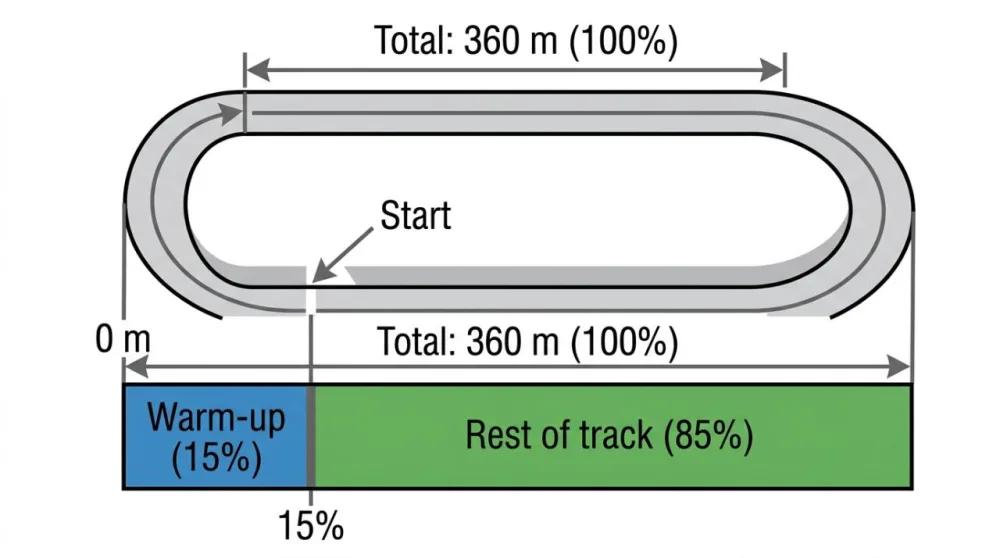
Solution: To find 15% of 360 m, first find 10% by dividing 360 by 10, which gives 36 m. Then find 5% by halving 36 m, which gives 18 m. Adding 10% and 5% together (36 m + 18 m) gives 54 m. 18 m is only 5%, 36 m is only 10%, and 72 m is 20%.
Look at the bar model representing the school library books and calculate the number of borrowed books.
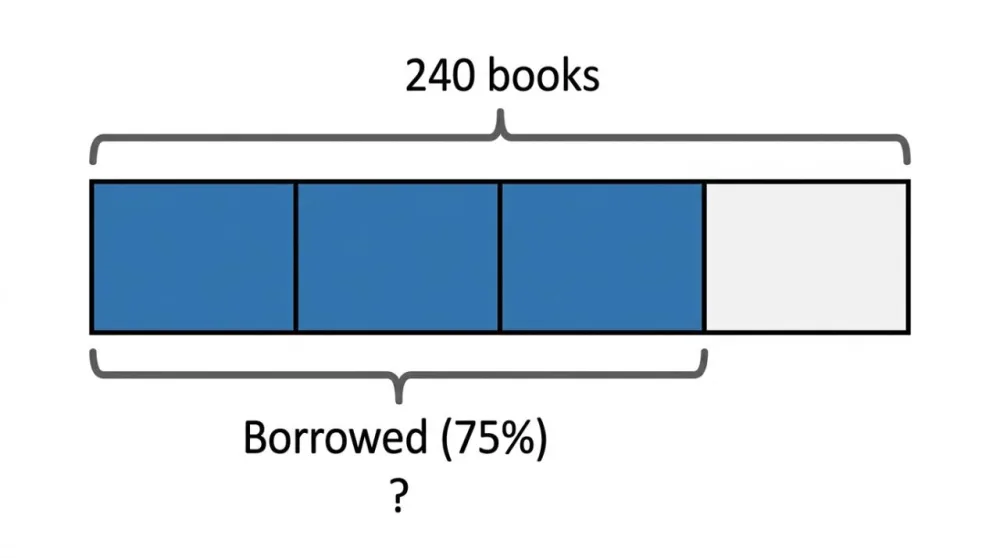
Solution: To find 75% of 240, convert 75% to the fraction 3/4. First find 1/4 of 240 by dividing 240 by 4, which gives 60. Then multiply by 3 to find 3/4: 60 × 3 = 180. Therefore, 180 books were borrowed. The value 60 is only 25% (stopping after finding 1/4), 120 is 50% (half of 240), and 160 is 2/3 of 240.
A photograph is enlarged to create a poster as shown in the diagram. What is the perimeter of the enlarged poster?
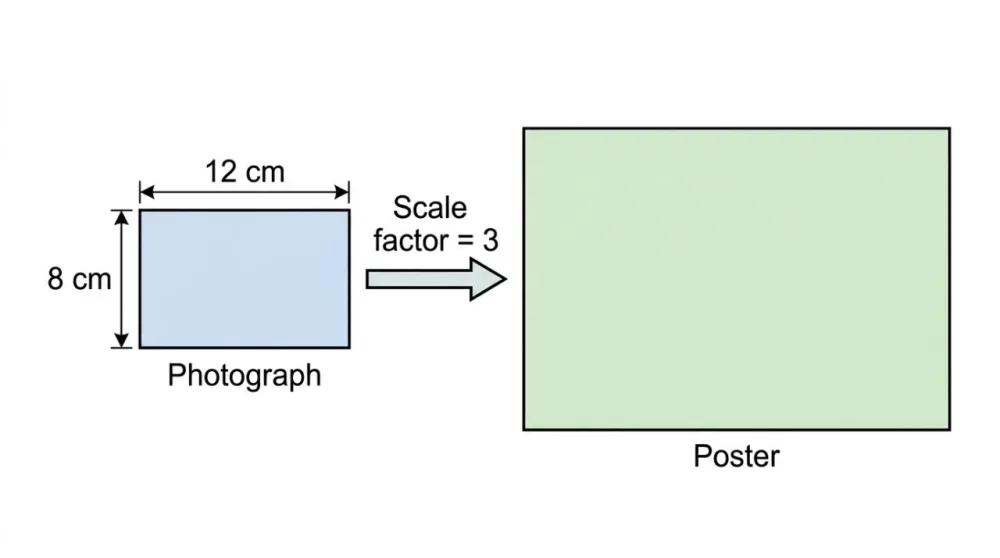
Solution: First, calculate the dimensions of the enlarged poster by multiplying each side length by the scale factor of 3: width = 8 cm × 3 = 24 cm, and length = 12 cm × 3 = 36 cm. Then find the perimeter: 2 × (24 cm + 36 cm) = 2 × 60 cm = 120 cm. Alternatively, find the original perimeter first, 2 × (8 cm + 12 cm) = 40 cm, and multiply by the scale factor: 40 cm × 3 = 120 cm. 40 cm is the original perimeter without enlargement. 60 cm is the semi-perimeter (width + length) of the enlarged poster. 288 cm is the area of the enlarged poster divided by 3, or confusing area and perimeter calculations.
A rectangle with a length of 6 cm and a width of 4 cm is enlarged by a scale factor of 3. The perimeter of the enlarged rectangle is 60 cm.
Solution: To find the dimensions of the enlarged rectangle, multiply each side length by the scale factor of 3: the new length is 6 cm × 3 = 18 cm, and the new width is 4 cm × 3 = 12 cm. The perimeter of the enlarged rectangle is 2 × (18 cm + 12 cm) = 2 × 30 cm = 60 cm. Alternatively, the original perimeter is 2 × (6 cm + 4 cm) = 20 cm, and multiplying the original perimeter by the scale factor of 3 also gives 20 cm × 3 = 60 cm. Therefore, the statement is True.
A baker uses 3/5 of a bag of flour on Monday and 3/10 of the original bag of flour on Tuesday. True or false: the baker has used more than 4/5 of the bag of flour in total.
Solution: To find the total fraction of the bag used, add 3/5 and 3/10. Convert 3/5 to tenths: 3/5 = 6/10. Adding the amounts gives 6/10 + 3/10 = 9/10. To compare 9/10 with 4/5, convert 4/5 to tenths: 4/5 = 8/10. Since 9/10 is greater than 8/10, the statement is true.
A jacket originally priced at £80 is reduced by 35% in a sale. The price of the jacket after the discount is £________.
Answer: 52
Solution: To find the sale price, first calculate 35% of £80. 10% of £80 is £8, so 30% is 3 × £8 = £24. 5% of £80 is half of £8, which is £4. Therefore, the 35% discount is £24 + £4 = £28. Subtracting the discount from the original price gives £80 - £28 = £52. Entering 52 completes the statement correctly.
A piece of ribbon measuring 72 cm in length is cut into two pieces in the ratio 3 : 5. The length of the shorter piece is ________ cm.
Answer: 27
Solution: The ratio 3 : 5 gives a total of 3 + 5 = 8 equal parts. The length of one part is 72 ÷ 8 = 9 cm. The shorter piece has 3 parts, so its length is 3 × 9 = 27 cm.
Each question is anchored to a graph, table or diagram, so pupils reach the answer by reading the visual.
Questions follow the curriculum for your topic, and every one comes with a short explanation of the correct answer.
Download the questions with an answer key and use them in a test, a worksheet or a revision lesson.
In Madlen a set of visual questions is ready in three steps.
Enter the topic and the year group for your questions.
Madlen builds curriculum-aligned questions around graphs, tables and images, so pupils reach the answer by reading the visual.
Download the questions as a PDF with the answers and a short explanation for each one, ready for a test or a revision lesson.
In Madlen’s Visual Question Generator you enter a topic and a year group. The AI designs questions built around graphs, tables and images. You can download them as a PDF with an answer key.
A visual question generator creates questions that pupils answer by reading a graph, table or image. Madlen’s Visual Question Generator builds these questions with AI and aligns them with the curriculum. It is one of more than 50 tools in the Madlen Toolbox.
You choose the topic and year group in Madlen, so the Visual Question Generator is not tied to one subject. It suits KS3 and GCSE science, geography and history, and one of our samples is a chemistry set on metallic bonding with diagrams.
Yes, Madlen exports visual questions as a PDF with an answer key. Each question also includes a short explanation of why the correct answer is right, which helps with marking.
Madlen has a free plan for UK teachers, and it starts with 14 days of Pro. You can compare what each plan includes on the Madlen pricing page.
Every new account starts with 14 days of Pro, so you can try the tools on this page with your own classes.